What Data Actually Reveal on DPA Loan Quality



Down payment assistance (DPA) has quietly become one of the most powerful — and most misunderstood — tools in mortgage lending.
Despite near-record availability and growing flexibility, persistent myths keep many lenders from fully using DPA to expand approvals, improve affordability and strengthen pipelines. The result? Qualified borrowers are declined unnecessarily, loan officers leave production on the table and lenders miss opportunities hiding in plain sight.
We think it’s time to separate fact from fiction. Below are eight of the most common myths lenders still believe about DPA and what the data actually shows.
Related: Down Payment Assistance Holds Near Record Levels in Q4 2025 as Program Flexibility Expands
Fact: DPA is not limited to low-income households.
Many programs are designed for moderate- and even higher-income buyers, particularly in high-cost or competitive markets. Income limits are typically tied to area median income (AMI), not a flat national number, which means caps can easily exceed six figures.
According to Down Payment Resource’s Q4 2025 Homeownership Program Index, 62% of programs have average income limits above $100,000, and 10% have no income limits at all — a 15% year-over-year increase. As affordability pressures push more middle-income households to the sidelines, DPA is increasingly supporting the “missing middle” — buyers who qualify for a mortgage but need help bridging cash gaps or reducing risk.
Why it matters: DPA has evolved from a niche safety net into a practical affordability and liquidity tool for today’s mainstream buyer.
Related: Stop leaving deals on the table: how lenders can use DPA to win the “missing middle”
Fact: DPA programs exist in every U.S. county.
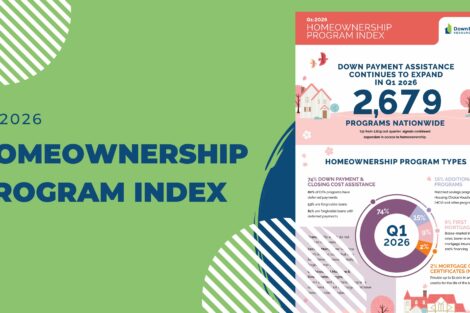
More than 2,600 homebuyer assistance programs are available nationwide, with over 2,000 counties offering 10 or more options. California leads with 353 programs, followed by Florida and Texas, and coverage is truly national.
The real challenge isn’t availability. It’s discoverability. Programs are offered at local, county, state and national levels, each with distinct rules that change frequently. Without a centralized source of truth, lenders are often operating with an incomplete or outdated picture of what’s available in their own footprint.
Why it matters: Missed opportunities are rarely about geography — they’re about visibility.
Fact: DPA does not inherently slow deals; late discovery does.
Manual research, outdated guidelines and last-minute eligibility checks are what cause delays. When DPA eligibility is identified early, teams make faster, more confident decisions.
When eligibility criteria are clear and surfaced early — rather than introduced as a Hail Mary — DPA can actually reduce back-and-forth, conditions and surprise fallout.
Why it matters: Speed comes from clarity and timing, not from avoiding assistance altogether.
Fact: Many declines are missed opportunities.
A significant share of borrowers who are declined for cash-to-close or debt-to-income (DTI) reasons are actually eligible for assistance that could have changed this outcome. These borrowers often fail due to liquidity constraints, not credit quality.
DPA can reduce upfront cash needs, restructure payments or improve loan-to-value ratios, but only when eligibility is evaluated before the file is written off.
Why it matters: Not every decline is a dead end. Some are simply a signal that assistance was surfaced too late.
Related: The Hidden Potential in Declined Loans
Fact: DPA benefits are often large enough to materially change loan outcomes.
Typical assistance amounts frequently range from $10,000 to $25,000 or more. On average, DPA reduces loan-to-value ratios by 8.8%, strengthening loan profiles and improving pricing and risk outcomes.
Programs can cover down payments, closing costs, prepaid expenses, mortgage insurance reductions and even rate buydowns. Some borrowers can layer multiple programs.
Why it matters: DPA doesn’t need to solve affordability entirely. It just needs to bridge the gap that keeps a qualified borrower from closing.
Fact: First-time buyer status is common, but far from universal.
While many programs target first-time buyers (typically defined as those who have not owned a home in the past three years), nearly 1,000 programs are open to repeat or move-up buyers. Eligibility often depends more on income, location or purchase price than buyer history.
Veterans and servicemembers are exempt from first-time requirements under 246 programs, and support for first-generation buyers continues to expand.
Why it matters: Assuming first-time buyer restrictions apply across the board unnecessarily shrinks the eligible borrower pool.
Related: Start the New Year Strong: Why Down Payment Programs Should Be Part of Your Homebuying Plan
Fact: Even the best loan officers can’t keep up without help.
Programs change constantly. Funding cycles open and close, income limits adjust and purchase price caps move. Even the most experienced loan officers rely on partial or outdated knowledge.
This isn’t an LO failure. It’s a data problem. Expecting individuals to manually track hundreds of shifting program rules is unrealistic and introduces inconsistency and risk.
Why it matters: Accurate, up-to-date program visibility levels the playing field and reduces reliance on guesswork.
Fact: Manual management doesn’t scale, but standardized data does.
Spreadsheets, PDFs and ad hoc research don’t scale. What feels like a capacity issue is often a tooling issue. When program rules are standardized, updated and embedded into workflows, lenders can manage hundreds of programs without increasing complexity.
Even starting with a free, centralized program database can dramatically expand what teams can confidently support.
Why it matters: The challenge isn’t the number of programs available; rather, it’s how they’re managed.
Related: Use the free search tool to find homebuyer programs
DPA isn’t niche, risky or operationally burdensome. It only becomes those things when discovery and eligibility are handled manually or too late in the process.
With the right system of record and workflow integration, DPA becomes a scalable, repeatable advantage, not a complication. The data already exists. The opportunity is already there. What lenders need now is earlier, clearer visibility into what borrowers actually qualify for.
Your hidden pipeline may be deeper than you think. Small changes — surfacing eligibility earlier, standardizing program data, and making program discovery easier for teams and borrowers alike — can create measurable lift in approvals, borrower confidence and production.
Down Payment Resource builds tools that help mortgage lenders, real estate agents, multiple listing services and consumer listing sites build relationships with homebuyers by connecting them with the down payment help they need.
To learn how Down Payment Resource can help you support homebuyers, contact us.