What Data Actually Reveal on DPA Loan Quality



June is National Homeownership Month, which makes it a natural moment to ask an uncomfortable question: Are we doing everything we can to help qualified buyers get into homes?
The answer, if we are being honest, is no. And a new national survey from New American Funding makes the case more clearly than any industry white paper could.
According to the survey of more than 1,000 homeowners, about 85% said there is something they wish they had known before starting the homebuying process. Nearly 21% wished they had known about down payment programs. Another 13% did not know they did not have to put 20% down. Nearly 44% said finding an affordable home was the hardest part of their entire buying experience.
These are not fringe findings. They describe the mainstream homebuying experience in America right now. And they point to a gap that real estate agents and lenders are uniquely positioned to close.
Part of the challenge is the word we keep using. The word assistance implies that down payment programs are a safety net for buyers who cannot afford to participate in the market any other way. That framing is both inaccurate and counterproductive.
Down payment programs are not charity. They are affordability tools. There is a meaningful difference, and it matters enormously for how we talk about them with clients.
Consider the buyer profile that rarely comes up in these conversations, let’s call them “the missing middle.” These are mortgage-ready consumers with steady incomes and solid credit who are hesitant to drain their savings to buy a home. They are not cash-strapped. They are cash-cautious. They are asking not “can I buy a house?” but “can I buy a house without emptying my emergency fund, my kids’ college account or the cushion that lets me sleep at night?”
The answer, in many cases, is yes. And the tool that makes it possible is a down payment program.
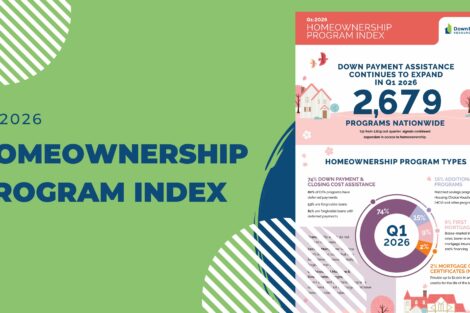
According to Down Payment Resource’s Q1 2026 Homeownership Program Index, every single U.S. county — all 3,143 of them — has at least one available program. More than 2,000 counties have 10 or more. There are currently 2,679 programs nationwide from more than 1,400 providers.
These programs average about $18,000 in benefits for homebuyers, enough to meaningfully reduce the upfront cash burden of buying and potentially lower a borrower’s loan-to-value ratio by an average of 8.8%. For a loan officer, that can mean moving a hesitant buyer across the finish line. For a real estate agent, it can mean the difference between a client who acts now and one who waits another two years.
And the programs are not just for first-time or lower-income buyers. Across Down Payment Resource’s database, 62% of available programs have income limits that can accommodate six-figure household incomes. Professional athletes ask about these programs. High earners ask about these programs. They are not a niche product. They are a mainstream affordability strategy that most buyers never hear about because most agents and lenders never bring it up.
The New American Funding survey found that 72.9% of homeowners would buy the same home again if they could do it over. But 37.2% said maintenance and repair costs were higher than expected, 25% were surprised by property taxes and 22% were caught off guard by utility bills. These are the realities of homeownership that no one is preparing buyers for well enough.
The conversation needs to expand. Not just “can you qualify?” but “have we looked at every tool available to help you buy without compromising your financial stability?” That means presenting every qualified buyer with at least two scenarios: one that incorporates available down payment programs and one that does not. It means treating affordability options as a standard part of the consultation, not an afterthought.
Down Payment Resource’s affordability intelligence platform makes that possible at scale. It is not a directory. It is a real-time eligibility engine that surfaces applicable down payment programs, closing-cost assistance and other affordable lending options at the point of qualification, so agents and lenders can have more complete, more useful conversations with every buyer they work with.
June is an opportunity, but it should not be the only month we have this conversation. The housing affordability crisis is not easing. Rates remain elevated, inventory is constrained and the buyers who need the most guidance are often the ones least likely to know that help exists.
The industry needs a structured forum for this discussion. A panel at MBA Annual on how lenders and agents can systematically integrate affordability tools into every buyer conversation would be a meaningful step. Not a session about why affordability matters, something we all know, but a practical, data-driven debate about how to drive this change. What does it look like operationally to make down payment program eligibility a standard workflow step? What does the evidence say about conversion when buyers are presented with program options versus when they are not? What are the lenders and agents already doing this well, and what can everyone else learn from them?
Those are the conversations worth having. We think National Homeownership Month is a good time to start.
Down Payment Resource builds tools that help mortgage lenders, real estate agents, multiple listing services and consumer listing sites build relationships with homebuyers by connecting them with the down payment help they need.
To learn how Down Payment Resource can help you support homebuyers, contact us.